


Reading is one of my favorite things to do in the world, and I have thanked God hundreds of times that it is part of my vocation. In 2025, I read or listened to the following, in no particular order.
* = one of my favorites of the year,
^ = one I’ve read many times and is in my hall of fame
The Case for Christian Nationalism
Boast Not Against the Branches
On Democracies and Death Cults
What it Means to Be Protestant*
The Ballad of the Whiskey Robber
Partial credit (haven’t yet finished them):
Know What You’re FOR: A Growth Strategy for Work, An Even Better Strategy for Life
Christianity: a Total World and Life System
A Beginner’s Guide to Dante’s Divine Comedy
Over the next few weeks, I am going to write about a few of these to try to convince you to read them as well.
The Brothers Karamozov, by Fyodor Dostoyevsky
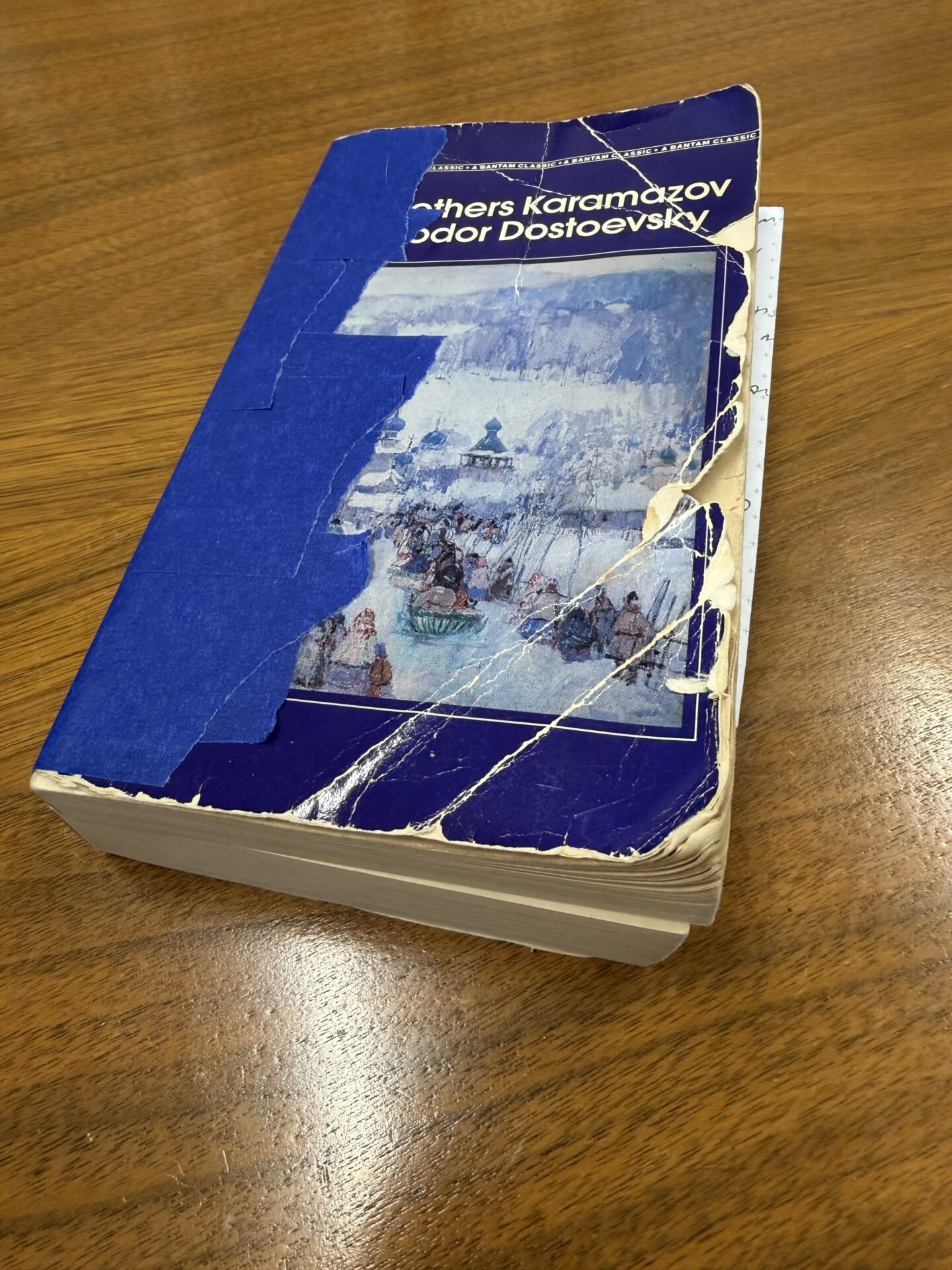
This long-winded, sprawling Russian novel is an absolute banger. Dostoyevsky is probably more well-known for his shorter, also incredible Crime and Punishment, but the Brothers K is superior. It is the story of a very dysfunctional family of the 1800s in Russia, headed by Fyodor Karamazov, a shrewd businessman in his 50’s who has accrued significant wealth in spite of his debased and self-centered existence. He is a dissolute, lecherous, moody, sneering, selfish man. He was a terrible husband two times over (widowed twice). His sons – Dmitri by his first wife, Ivan and Alyosha by his second – are utterly neglected by their father during childhood. Absorbed in drink, women, and work, he pays scant attention to them, and seems even to forget that they are alive and his responsibility to shepherd them. They are raised by others – a servant in one case, in-laws in another.
The story begins in the boys’ young adulthood, with all three coming back to their father’s hometown in their 20’s. As anyone with children can attest, they are born with innate and profound differences of personality and proclivity, and the Karamazov bros are no different. Dmitri, the oldest, is the most like his father – ruled by his passions, self-centered, and hungry for the inheritance that he believes he deserves. Ivan, the middle son, is a brilliant atheist who despises his father, yet remains in town, living with him. The youngest, Alyosha, is the moral center of the story. He is an ardent, young Christian, earnest and kind. There is another son, an illegitimate one, who figures into the tale, but that would take too long to explain. Suffice it to say that there is a murder, a mystery, a trial, several love triangles, and plenty of theology and philosophy in this tome of a story. What’s not to like! Well, here is what I like about it in particular:
1) The astounding depth and complexity of each character, which reveals the truth about ourselves and the people we love.
Dostoyevsky is a master of illuminating the many foibles, contradictions, and idiosyncrasies that we all possess. The depths of human depravity run deep, and the nobility of grace and love soar to the heights. Early on in the book, we are introduced to a religious figure, an Orthodox “elder” (akin to the lead monk of a monastery) named Zossima. People come from all over Russia to ask his advice and have him pray for them. One woman, a shallow, well-heeled matron, describes to Zossima her struggle to love “mankind.” She tells him that she loves mankind in general, but has difficulty loving those around her. Zossima tells her not to worry about such high-minded thoughts of loving mankind in general, but to perform acts of love concretely instead:
“A true act of love, unlike imaginary love, is hard and forbidding. Imaginary love yearns for an immediate heroic act that is achieved quickly and seen by everyone. People may actually reach a point where they are willing to sacrifice their lives, as long as the ordeal doesn’t last too long, is quickly over — just like on the stage, with the public watching and admiring. A true act of love, on the other hand, requires hard work and patience . . . But I predict that at the very moment when you see despairingly that, despite all your efforts, you have not only failed to come closer to your goal but, indeed, seem even farther from it than ever — at that very moment, you will have achieved your goal and will recognize the miraculous power of our Lord, who has always loved you and has secretly guided you all along.”
How true this is (for me at least)! I am more than capable of high-minded feelings of love for “the poor” or “the downcast” from afar. It is much, much more difficult to actually love the person who needs help when it is inconvenient, who isn’t grateful, who doesn’t follow my advice, who doesn’t smell quite the way he should. And yet, if we are willing to love that person without expecting anything in return, we imitate our Lord, who loved us because of His mercy, not because of our utility to Him.
Later, we are introduced to a boy named Ilyusha, who is being ganged up on in a heartbreaking scene by six schoolmates. Ilyusha is a fiercely proud, seemingly vicious 8 year old, furious with the world, who is throwing rocks at a group of six boys while the boys return fire. The protagonist of the novel, Alyosha, happens to come across the fight and tells the six to stop ganging up on the runty Ilyusha. While he is talking with them, “whap!”, a stone painfully hits Alyosha in the shoulder. The six boys unleash a volley, hitting the poor boy in the head and chest. He runs off crying and cursing, and Alyosha pursues, pitying him. When Alyosha comes near, the boy turns, sprints toward him, and, animal-like, chomps down on Alyosha’s hand, cutting him to the bone, and runs away. After stopping at a friend’s home to visit (and get bandaged), Alyosha finds little Ilyusha’s home. It is a hovel, a place of squalor and suffering. His father Snegirev is nearly out of money, with a wife who is out of her mind and in need of constant care, and a daughter who is wheelchair bound. As he steps inside, Alyosha is humble, courteous, and without an ounce of condescension. He understands immediately how much suffering there is in this home, and later finds out that there is good reason for little Ilyusha to hate the name Karamozov.
Snegirev and Alyosha take a walk outside, and Snegirev explains the reason his son is picked on, and why he is so filled with rage at the world. A few months prior, Snegirev was publicly humiliated in the most degrading way by Alyosha’s dissolute older brother (hence the hatred towards Alyosha). Instead of quietly enduring the teasing from the boys as a result of his father’s humiliation, Ilyusha defends him ferociously. His father tells him:
“Schoolboys are a merciless breed. Taken individually, they may be little angels, but in a crowd they’re completely without pity. So they started taunting him and it aroused his sense of honor. Another boy with less character would have resigned himself and just become ashamed of his father, but this one decided to stand up for his father, one against the world. He wants to defend his father and uphold truth and justice.”
All of this leads to a tragic end, but one in which these boys who were against him, led by Alyosha, reconcile and make the tragedy endurable.
I am only scratching the surface of the depth of human experience Dostoyevsky reveals in his masterpiece. Here is a second reason to love this novel:
2) It shows the beauty of the Christian life and the unendurable confusion and aimlessness of life apart from God.
As I wrote above, Dostoyevsky is masterful at creating complex, three-dimensional characters. The three brothers, Dmitri, Ivan, and Alyosha, are strikingly similar in important ways, yet they are miles apart in their essential motivations and values.
Dmitri, the oldest, is most like his father – ruled by his passions, a heavy drinker, and prone to bar fights. He has an obsessive desire for one woman in particular (in a Jerry Springeresque turn, the same woman his father is obsessed with). And yet, Dmitri also displays a sensitivity that allows him to see the depths of his own depravity, and lament that depravity. He can see that Alyosha, his younger brother, lives with a different purpose. He also senses that Alyosha truly loves him in spite of Dmitri’s own sins. In his best moments, Dmitri longs for Alyosha’s purity of heart, and his fits of exuberant generosity (often to his own detriment) reveal this longing.
Ivan, the middle son, is “wicked smaahht.” His cerebral, atheistic rationalism, though, fails to anchor him. How could it? “The fool says in his heart, ‘There is no God’” (Psalm 14:1). He lives within the prison of his own cold intellectual tower, believing that the world is meaningless. He understands the philosophic reasons to doubt God’s existence very well, and articulates them with devastating clarity (of which, more below). One of his central conclusions as an atheist is that “if there is no God, then everything is lawful.” This idea, of course, has consequences, among those he influences, and within his own increasingly tormented heart. Ivan believes this to be true rationally, and yet his conscience will not bear the implications of a world that is accidental, meaningless, and devoid of a moral framework. Because of the events that unfold in his family, the tension between his atheistic rationalism and his lived experience of the moral, meaningful world, nearly undoes him.
Finally, Alyosha. The youngest son is the center of Dostoyevsky’s narrative. He is, to quote Jesus describing Nathaneal, “a man in whom there is no guile” (John 1:47). (Alyosha also reminds me of Tanner Fixari, and if you call Tanner ‘Alyosha’ the next time you see him I will be grateful). The youngest Karamazov is a devout, kind-hearted, gentle Christian man. He believes the best of everyone around him. Some think him naive, and yet he is also quite adept at understanding the subtle and hidden motives of his friends and family. He is a man of faith, but has his own deep struggles. When his mentor and hero dies, and a dramatic disappointment ensues, he goes through a dark night of the soul and stands on the precipice. But he is rescued by the grace of God from committing a catastrophic sin which would have destroyed several relationships. Rather than rashly abandoning himself to the characteristic “Karamazov sensuality,” he ends up not only resisting the temptation, but dramatically impacting the very woman who sought Alyosha’s downfall. By the force of his own humanity and love, and his ability to see the goodness in her, Alyosha ennobles her. He does this over and over in the novel, seeking the good of those whom God puts in his life, without judgment or self-righteousness. He is a model for all of us.
His father, though a lecherous, cynical, greedy man, a man who knows that no one loves him and that he is undeserving of anyone’s love, still understands that Alyosha loves him. In a moment of clarity, he blurts out,
“You do love me, my dear boy, I know you do,” he said suddenly, “though I am a scoundrel… You’ve loved me all your life, and I know it.
His eldest brother Dmitri, obsessive, paranoid, and wild, knows that Alyosha loves him as well.
“Alyosha, you are the only one in the world who has ever loved me. You are on my side — you always were, even when I was ashamed to look at you.”
Alyosha adds salt and light wherever he goes. He is no pushover or pansy, but rather a meek, faithful, kind, loving man who blesses all of those who cross his path. He is not the smartest or most charismatic, but he “knows whom he has believed” (2 Timothy 1:12), and spreads His love abroad to all he encounters. Finally,
3) The Brothers K has within it the two most powerful chapters in literature about the problems of Christian belief.
There are two chapters in the middle of the book that contain a dialogue between Ivan and Alyosha, called “Rebellion” and “The Grand Inquisitor.” They are brilliant. “Rebellion” takes up the problem of evil. In its philosophical form, the problem can be stated with three premises:
- God is good.
- God is all-powerful.
- Suffering and evil exist.
This is indeed a philosophical challenge, one that Christians have answered throughout the millennia in ways that are satisfying, at least to me. But Dostoyevsky makes such an eloquent, moving case for this problem through Ivan that it troubles me every time I read it. Ivan focuses only on the suffering of children to make his case. Adults “have taken a bite of the apple,” so to speak. They have sinned, and whatever happens to adults, in some way their sinfulness has contributed to the aggregate suffering of others, and so might be justified. But the suffering of children? How could a good, all-powerful God allow such depths of suffering among children? How could He allow a peasant child to be ripped to pieces by the hunting dogs of a wealthy landowner, in front of the boy’s mother, to “teach him a lesson” about accidentally hitting the paw of one of his prized dogs with a stone? How could God allow a 5-year-old girl to be locked in an outhouse overnight for soiling her pants by calloused, uncaring parents in the sub-zero weather, while the confused, weeping girl prays to “dear, kind Jesus” for help? This, Ivan tells Alyosha, is why he cannot bring himself to worship Alyosha’s God.
“For the hundredth time I repeat, there are many questions that could be asked, but I ask you only one about the children because I believe it conveys fully and clearly what I am trying to tell you. Listen, even if we assume that every person must suffer because his suffering is necessary to pay for eternal harmony, still do tell me, for God’s sake, where the children come in. I can understand the concept of solidarity in sin and also solidarity in retribution. But how can there be solidarity in sin with small children? And if it is true that children share the responsibility for the sins committed by their fathers, then that concept must be true in some different world from the world I know, and it is quite beyond my grasp.”
This, Alyosha responds, is “rebellion.” Ivan rejects God’s promise to make all things right, to wipe away every tear, because Ivan cannot understand how God’s cosmic providence would include the suffering of children (interestingly, Dostoyevsky collected these and other real-life, heart-rending stories from the local papers).
Alyosha points to the cross as God’s answer to suffering – Jesus, the Eternal Son, blameless and pure, entered into human suffering on our behalf in order to redeem us from our own sin and suffering. This is a great answer! But it is not convincing to Ivan, and he tells Alyosha a parable in the next chapter about a Cardinal during the Spanish Inquisition, who happens to encounter Jesus Himself. Jesus is not returning to end all things as in the book of Revelation, but to comfort the weak and strengthen the faithful by visiting His people. It is a fascinating parable about the cost of human freedom – why did God not simply create us to not sin, rather than pay the tremendous cost of our freedom, which led to human sin, which continues to lead many people to perdition? This is the crux of the parable, during which the Inquisitor questions Jesus about the three temptations in the desert, and how, if Jesus had given in to either of the three temptations, humanity would have been helped, not harmed, by our freedom.
Dostoyevsky himself was a skeptic and a socialist early in his life, until he was arrested and sentenced to death for his illegal political views (which were utopian socialist, broadly). At the last moment, after being brought before a firing squad, his sentenced was reduced, and he spent four years in Siberia at a prison labor camp. This harrowing experience led him to recommit to his Russian Orthodox faith. His near death experience led him to faith following years of doubt. Ironically, his own suffering surely led him to faith, and it also forged his narrative imagination through which he explores these themes. Dostoyevsky’s God-given talents and Herculean efforts as a writer produced, like coal under immense pressure under the weight of the mountain, a dazzling, multi-faceted diamond in this epic novel.
There is more about The Brothers K that I love (it is laugh out loud hilarious in places, and also moves me to tears), but I have written too much already. Give this book a shot. Listen to it if that is easier. But don’t give up. It is an absolute masterpiece.
Pastor David Milroy